
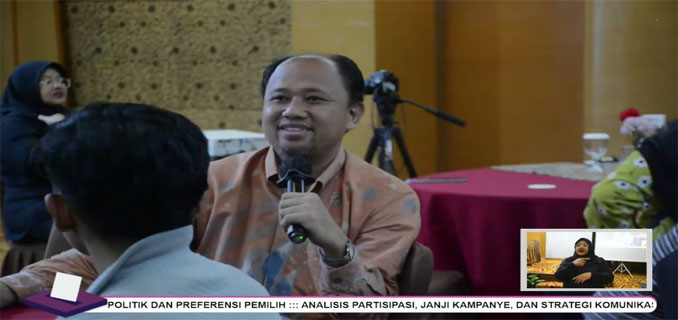
Daftarsbmptn.com – The public’s hope that direct regional head elections (Pilkada) would produce leaders sensitive to the people and minority issues has failed to materialize. This was conveyed by Dr. Ridho Al-Hamdi, M.A., a lecturer in Government Science (IP) at Muhammadiyah University (UMY), when contacted boldly on Friday (October 31).
“According to Ridho, the main problem with direct regional head elections today is co-optation by “bandars” or capitalists. Specifically, elected leaders are preoccupied with trying to “recoup their capital” in the first two years of their term, instead of listening to the people’s voice.”
“The public’s hope that direct regional head elections would produce leaders sensitive to the people has in reality been co-opted by “bandars,” by so-called capitalists,” he asserted, as also conveyed at the Research Review:
Dynamics of Political Narratives and Voter Preferences event held by the LKiS Foundation on Thursday (October 30) via Zoom.
The high cost of politics was also highlighted, with Ridho even citing the budget for members of the Indonesian House of Representatives (DPR RI) reaching Rp 705 million per visit, totaling Rp 3.5 billion per member annually. He reviewed the allocation of recess funds, which are supposed to be used to gather public input, such as in the Special Region of Yogyakarta (DIY), where the total funds can reach Rp 20 billion for eight DPR RI members, yet no tangible benefits have been seen for the public.
Furthermore, Ridho exposed the practice of money politics and the astronomical cost of seats. He confirmed the North Barito Pilkada case at the Constitutional Court (MK) involving political money of Rp 16 million, which he claimed was even higher after being confirmed with the Corruption Eradication Commission (KPK). He also mentioned the phenomenon of seat buying and selling at the party’s Central Executive Board (DPP), with examples such as in East Kalimantan, where the price of support per seat can reach Rp 2 billion, sold in packages.
In the context of election oversight, Ridho criticized the weaknesses of the existing system, even synchronizing it with recommendations for the dissolution of the Integrated Law Enforcement Center (Gakkumdu). He considered Gakkumdu ineffective because Bawaslu only had one vote compared to the two votes of the Prosecutor’s Office and the Police, complicating the election judicial process.
“For me, it’s enough. If you want to strengthen it, just disband Gakkumdu and give Bawaslu the authority to act as a judicial body,” he suggested.
At the end of his presentation, Ridho stated that all that remains in this Republic is the power of civil society. He encouraged civil society to continue speaking out, sometimes even “loudly,” as he believed the government needed to be toughened up to listen to criticism. He cited cases that were won through public pressure.
888slot 888 slot thường xuyên tổ chức các sự kiện đặc biệt và tri ân hội viên VIP với những phần quà có giá trị cao, khẳng định sự trân trọng đối với mọi thành viên. TONY02-03