
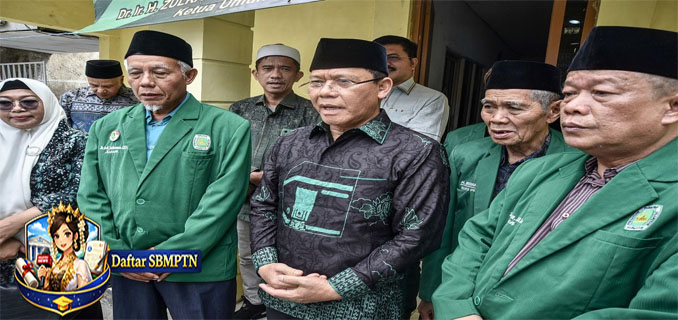
Daftarsbmptn.com – The Chairman of the United Development Party (PPP), Mardiono, has once again captured public attention after his statement in a viral video stating that his party needs at least IDR 1 trillion to regain a seat in the House of Representatives (DPR) in the upcoming elections. This statement immediately sparked widespread discussion on social media and among political observers regarding the current high cost of politics in Indonesia.
In the video, taken after opening the 10th PPP Regional Conference (Muswil) for West Sumatra Province in Padang, Mardiono explained that the party’s internal calculations indicate the need for significant capital to mobilize the political machinery at the grassroots level. According to him, the funds are not only for campaign logistics, but also to ensure the party’s structure is firmly established throughout the region, including at the sub-district and polling station (TPS) levels.
“We’ve done the calculations it will take one trillion rupiah for the PPP to return to parliament in the upcoming elections,” Mardiono said in the interview.
This statement immediately drew attention, especially because the United Development Party (PPP) failed to win a seat in the House of Representatives (DPR) in the previous election, forcing the party with the Kaaba symbol to work extra hard to return to the national parliament. Mardiono also emphasized that the current political costs are extremely high and pose a challenge not only for the PPP but also for other parties striving to gain public support.
Public and Expert Responses to Political Costs
Public reactions to Mardiono’s statement were mixed. Some viewed this admission as a clear illustration of how money and financial resources have become a significant factor in Indonesian politics. In the same context, political observers often highlight that political party campaigns and activities on the ground from installing campaign materials to consolidation activities at the village level require significant costs. Even at the regional legislative level, legislative candidate expenditures are estimated to reach billions of rupiah per electoral district.
However, there has also been considerable criticism. Some questioned whether the need for such large funds reflects the party’s reliance on traditional ‘campaign money,’ which has often been associated with money politics and unequal opportunities among candidates. This issue raises a broader question: does the current political system favor large parties or those with stronger financial access? This question becomes increasingly relevant in the run-up to the election, when competition for legislative seats is intensifying.
Challenges for Political Parties and Organizational Infrastructure
In his explanation, Mardiono referred not only to the monetization aspect of campaigns, but also to the strength of a party’s organizational infrastructure. He stated that having substantial logistics alone does not guarantee victory if the party’s internal organs are not felt by the people at the grassroots level. The United Development Party (PPP), Mardiono said, must build structures down to at least the sub-district level to be competitive.
“The current political costs are indeed quite high. So if a party, certainly not just the PPP, doesn’t prepare adequate logistics, it will certainly be difficult,” he added.
This statement demonstrates that parties compete not only on ideas or programs, but also on managing resources and effective political organizational strategies at all levels. The conventional campaign model that still dominates in Indonesia which requires face-to-face meetings, distribution of campaign materials, and mobilization of volunteers unwittingly consumes significant resources.
Highlighting Political Costs and the Role of Regulation
The focus on the high cost of politics in Indonesia is nothing new. Researchers and anti-corruption institutions frequently cite high campaign costs as a contributing factor to the practice of money politics and the potential for corruption. Public discussions frequently raise the need for political funding reform, including more transparent public funding options or limits on campaign spending to ensure fairer competition.
Furthermore, several parties have proposed strengthening audit and oversight mechanisms for the use of party and campaign funds, including publicly accessible internal audits, so that political contests do not rely solely on capital.
Facing the Election, Balancing Money and Ideas
Ahead of the upcoming election, Mardiono’s statement serves as a reminder that political costs and organizational structures play a significant role in power dynamics in Indonesia. How the United Development Party (PPP) and other parties manage this challenge will be a determining factor in the fight for parliamentary seats. Meanwhile, the public continues to monitor whether these high costs will impact the quality of democracy or widen the gap in inequality in the national political arena.
1хбет букмекерская контора, 1xbet слоты
предлагает горизонтальный спектр ставок на подии.
My blog; https://1xcasino-official.lol/
мелбет букмекерская контора,
melbet перейти на сайт предлагает широкий выбор спортивных диспутов для игроков.
1хбет букмекерская контора, 1хбет зеркало на сегодня размещает широкий выбор спортивных событий для ставок.
Also visit my site https://1xbet-pin.xyz/
Finding cost-effective options for parking can make
your travel experience smoother. Consider Airport ParkingDeals, https://wakelet.com/@airportparkingdeals, which offers excellent prices and convenient locations.
Giao diện slot365 apk tối màu giúp bảo vệ mắt khi chơi lâu – chi tiết nhỏ nhưng thể hiện sự chăm sóc người dùng tận tâm. TONY04-14H
Điều làm mình thích moviebox pro là hoạt động khá ổn định vào buổi tối. TONY09-03