
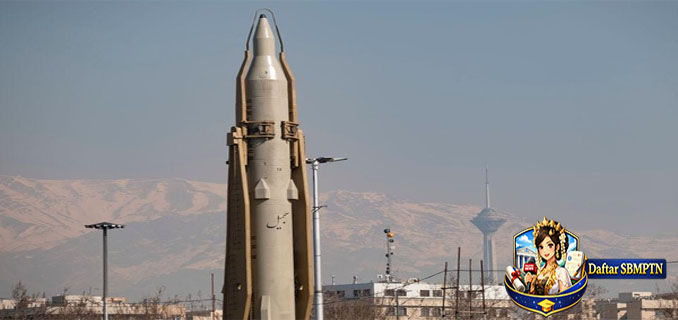
Daftar Sbmptn – The armed conflict between Iran and Israel has entered a more dangerous phase after Iran launched Sejjil ballistic missiles towards Tel Aviv in its 54th wave of attacks. This attack marked a military escalation that has sparked widespread concern in the international community about the possibility of a wider war in the Middle East.
According to an official statement from Iran’s Islamic Revolutionary Guard Corps (IRGC), this latest wave of attacks is part of an Iranian military operation targeting various Israeli military and strategic facilities. In this operation, Iran reportedly used Sejjil missiles for the first time since the latest conflict with Israel escalated in recent weeks.
International media reported that several missiles were aimed at the Tel Aviv metropolitan area, including areas close to diplomatic and military facilities. Air raid warning sirens sounded in several Israeli cities, forcing residents to rush to emergency shelters.
Sejjil Missile, Iran’s Strategic Weapon
The Sejjil missile is known as one of Iran’s strategic weapons systems, possessing medium-range capabilities with a range of approximately 2,000 to 2,500 kilometers. This missile uses a two-stage solid-fuel system, allowing for faster launch and greater difficulty in pre-launch detection than liquid-fueled missiles.
Military analysts say this capability makes the Sejjil a serious threat to air defense systems. Some reports have even dubbed it the “dancing missile” because its flight path can change, making it difficult for radar and interceptor systems to detect.
The use of this missile in the current conflict is seen as a signal that Iran is willing to deploy its more advanced military technology in response to previous Israeli attacks.
Background to the Escalation of the Conflict
Tensions between Iran and Israel escalated sharply following a major military strike launched by Israel with the support of the United States against several strategic targets in Iran in late February 2026. The operation, known as “Lion’s Roar,” targeted military facilities and infrastructure suspected of being linked to Iran’s defense program.
In retaliation, Iran launched numerous missile and drone attacks against Israel and several targets linked to American interests in the region. Since then, hundreds of ballistic missiles and drones have reportedly been used by both sides in the retaliatory attacks.
The 54th wave of attacks shows that the conflict shows no signs of abating. In fact, several countries in the region have begun to increase their military readiness due to concerns that the conflict could spread to other countries in the Middle East.
Regional and Global Impact
The escalation of the Iran-Israel conflict has not only impacted regional security but has also sparked global concern. Tensions in the Middle East have disrupted key global energy trade routes, including around the Strait of Hormuz, a vital route for international oil shipments.
Some analysts warn that if the conflict continues to escalate, the impact could extend to the global economy, particularly on energy prices and international market stability. Furthermore, major powers such as the United States, Russia, and European countries continue to monitor the situation closely while calling for de-escalation.
In Israel, the government stated that the country’s air defense system remains on high alert to counter possible further attacks. Meanwhile, Iran asserts that the missile attacks are part of its right to retaliate against military action against its territory.
The Situation is Still Developing
To date, reports regarding the number of casualties or damage resulting from the latest wave of attacks are still being updated. However, observers believe the use of Sejjil missiles in this conflict marks a new stage in the military confrontation between the two countries.
With the increasing intensity of attacks and the use of increasingly sophisticated weaponry, the international community now faces a significant challenge in preventing the Iran-Israel conflict from escalating into a broader regional war.