Daftar Sbmptn – Indonesia continues to rely on an independent and active foreign policy as its primary strategy in addressing increasingly complex global geopolitical dynamics. This diplomatic principle is considered capable of strengthening Indonesia’s position on the international stage while maintaining global stability amidst increasing interstate conflict.
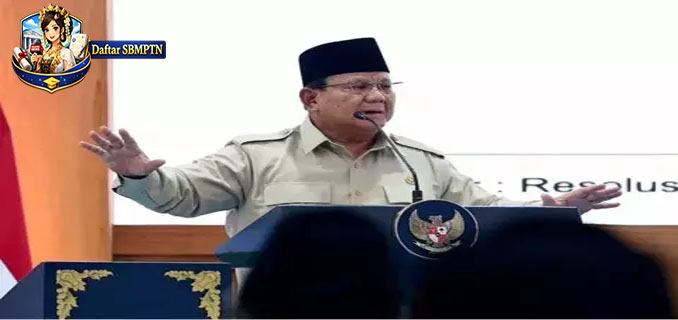
President Prabowo Subianto emphasized that Indonesia remains committed to the principle of an independent and active policy in responding to the various international crises currently developing. The government is committed to maintaining an independent position without siding with any particular power bloc, while actively contributing to creating global peace and cooperation.
The principle of an independent and active policy has been the foundation of Indonesian foreign policy since the beginning of independence. In practice, this approach means that Indonesia is not tied to military or political alliances with major powers, but remains active in international diplomacy. In a global situation full of uncertainty, this approach is considered relevant for safeguarding national interests while contributing to global stability.
Global geopolitical tensions, including the conflict in the Middle East involving the United States, Israel, and Iran, are among the challenges facing the international community today. These conflicts demonstrate the increasingly complex dynamics of international relations and have the potential to impact economic stability and global security.
Amidst this situation, Indonesia strives to act as a bridge for dialogue between countries. Indonesian House of Representatives Speaker Puan Maharani emphasized that Indonesia’s independent and active policy must be consistently implemented to respond to global geopolitical developments. According to her, Indonesian diplomacy needs to be conducted wisely, constructively, and oriented toward national interests.
In addition to government diplomacy, Indonesia is also strengthening parliamentary diplomacy and international cooperation with various countries. These efforts are carried out through inter-parliamentary communication and international forums to encourage dialogue and peaceful conflict resolution.
At the global level, Indonesia is also involved in various international forums and collaborations. This involvement demonstrates that, while not aligned with any particular bloc, Indonesia remains active in establishing strategic partnerships with various countries and international organizations. This participation is considered crucial for expanding Indonesia’s diplomatic influence and strengthening the country’s position in facing global challenges.
In the context of the Indo-Pacific region, Indonesia is also expanding security and defense cooperation with several partner countries. This step is taken to maintain regional stability and address the various security challenges emerging in the region.
International relations observers assess that Indonesia’s consistent implementation of an independent and active policy is a crucial asset in building international trust. By not siding with any particular bloc, Indonesia can play a role as a mediator or balancer on various global issues.
Furthermore, this approach also provides Indonesia with flexibility to collaborate with various countries in the fields of economics, security, and development. In an increasingly fragmented global situation, the ability to build relationships with multiple parties is a strategic advantage for Indonesia.
Going forward, geopolitical challenges are expected to become increasingly complex with increasing rivalry between major powers, changes in the global economy, and various regional conflicts. In these conditions, the policy of free and active participation remains relevant as a guideline for Indonesian diplomacy.
Through this policy, Indonesia not only safeguards national sovereignty and interests but also strives to contribute to the creation of peace, stability, and stronger international cooperation amidst the evolving global crisis.