
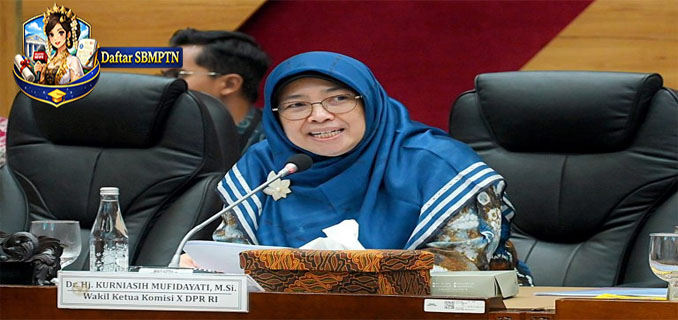
Daftar Sbmptn – The Deputy Chairperson of Commission X of the Indonesian House of Representatives, Kurniasih Mufidayati, expressed her support for the government’s policy of issuing Presidential Regulation Number 3 of 2026. This policy is considered a strategic step to address the issue of approximately three million Indonesian children who are still outside the formal education system.
According to Kurniasih, the regulation demonstrates the state’s commitment to ensuring every child has the basic right to education. She emphasized that education is the main foundation for human resource development and is key to the nation’s future progress.
“The government’s policy through the Presidential Regulation on addressing children who are out of school is a strategic step that deserves support. The state must ensure that no Indonesian child loses their right to education,” Kurniasih said in Jakarta.
She explained that the issue of children who are out of school is a serious challenge to the national education system. Based on government data and development planning, the number of children who are out of school in Indonesia is estimated to be around three million. This situation is a concern because it has the potential to hinder the improvement of human resource quality in the future.
Kurniasih believes that the problem of children who are out of school is not solely related to the education sector but is also influenced by various social and economic factors. Many children are forced to drop out of school due to family economic circumstances, having to help their parents work, and limited access to education in remote areas.
Therefore, she emphasized the importance of a comprehensive approach in implementing the Presidential Regulation. According to her, mitigation efforts must involve various parties, from the central government, local governments, and the community, for the policy to be truly effective.
The government itself issued Presidential Regulation No. 3 of 2026 as a national policy to prevent and address out-of-school children in an integrated manner. This regulation aims to strengthen cross-sector coordination and ensure that children who have not or are no longer attending school can return to education services.
The regulation requires the government to conduct more accurate data collection on out-of-school children throughout Indonesia. Integrated data is considered crucial for policy interventions to be targeted and sustainable.
Furthermore, the Presidential Regulation also emphasizes preventative measures so that children at risk of dropping out of school can receive immediate support, both through educational assistance and social protection programs. This approach is expected to reduce the dropout rate and increase participation in national education.
Kurniasih added that the government also needs to strengthen the various educational assistance programs currently in place. Programs such as educational assistance for low-income families are considered crucial to ensuring that children from vulnerable groups can continue their education.
She also encouraged the strengthening of alternative educational pathways for children who have already dropped out of school. Non-formal education, skills training, and vocational programs can be solutions to ensure they continue to have learning opportunities and are equipped for the future.
She believes that schools and teachers also play a crucial role in early detection of potential dropouts. With a better monitoring system, children at risk of dropping out of school can receive immediate support before they completely drop out of the education system.
Kurniasih emphasized that addressing the issue of children out of school must be a collaborative effort involving many parties. She hopes that collaboration between the government, educational institutions, and the community can open broader educational opportunities for all Indonesian children.
“Addressing the issue of children out of school must be a collaborative, cross-sectoral effort. With strong collaboration, we can ensure that every Indonesian child remains on the educational path,” she concluded.
With support from various parties and consistent policy implementation, the government hopes the number of children out of school can continue to decrease. This effort is also an important step towards realizing more inclusive and equitable education throughout Indonesia.