
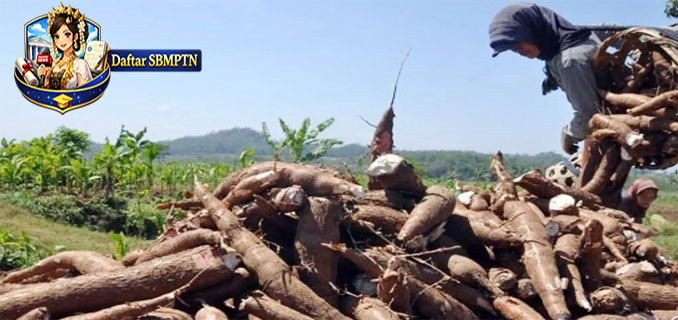
Daftarsbmptn.com – The role of cassava as a national strategic commodity is gaining increasing attention as Indonesia’s need to strengthen economic resilience and accelerate the energy transition grows. This local food commodity is considered to have significant potential not only as an alternative food source but also as a raw material for renewable energy and bioeconomy-based industries.
Several economic, energy, and agricultural experts assess cassava as having strategic advantages due to its ease of cultivation, adaptability to various soil conditions, and high added value when further processed. In the context of national economic resilience, integrated cassava development is believed to be able to reduce dependence on food and energy imports, while simultaneously strengthening the rural economy.
Cassava has long been known as an alternative carbohydrate source for the community. However, in recent years, its role has expanded further as an industrial raw material, from tapioca flour and animal feed to bioethanol, a key component of the renewable energy mix. This aligns with the government’s agenda to reduce carbon emissions and reduce dependence on fossil fuels.
Agricultural economists believe that strengthening cassava as a strategic commodity can create a multiplier effect on the national economy. In the upstream sector, increased cassava production will create jobs for farmers and rural workers. Meanwhile, in the downstream sector, the cassava processing industry has the potential to drive the growth of manufacturing based on local raw materials.
“Cassava has a long value chain. If managed properly, from cultivation, processing, to distribution, this commodity can become a pillar of national economic resilience,” said an energy economics observer.
He added that cassava development also aligns with efforts to achieve equitable development, as many production centers are located in non-urban areas. In the context of the energy transition, cassava is considered strategic as a raw material for bioethanol. Cassava-based bioethanol can be used as a blend of biofuels for vehicles, thereby helping reduce fossil fuel consumption. Furthermore, the use of biomass-based energy from cassava also has the potential to support greenhouse gas emission reduction targets.
The government itself is encouraging the diversification of renewable energy sources to achieve the national energy mix target. To date, the focus of bioenergy development has largely been on palm oil. The presence of cassava as an alternative is considered important to reduce the risk of dependence on a single commodity and maintain environmental sustainability.
However, developing cassava as a strategic commodity still faces several challenges. National cassava productivity is considered suboptimal, while farmers’ access to technology, financing, and markets remains limited. Furthermore, price fluctuations and a lack of market certainty are often major obstacles for farmers in increasing production.
To address these challenges, integrated policies involving various sectors are needed, from agriculture and industry to energy and finance. Support for research and technological innovation is also key to increasing cassava productivity and quality, including the development of superior varieties and more efficient processing technologies.
Strengthening farmer institutions and partnerships with industry are also considered crucial for a more stable cassava supply chain. With a clear partnership scheme, farmers receive price and market certainty, while industry obtains a sustainable supply of raw materials.
In addition to economic and energy benefits, cassava development also has a strong social dimension. This commodity can be an instrument for empowering rural communities and strengthening local food security. In a climate of global economic uncertainty, the existence of strategic commodities based on local resources is becoming increasingly important.
Going forward, it is hoped that cassava will no longer be viewed as a second-class food commodity, but rather as a national strategic asset. With the right policies and cross-sector support, cassava is believed to be able to contribute significantly to strengthening Indonesia’s economic resilience while encouraging the transition to a cleaner and more sustainable energy system.
Tham gia XN88 là một quá trình đơn giản, nhanh chóng và bảo mật. Với giao diện được thiết kế tối ưu cho người dùng Việt Nam, việc bắt đầu trải nghiệm nhà cái đổi thưởng trở nên dễ dàng ngay cả với những người mới làm quen với thế giới giải trí trực tuyến. TONY06-22
Sau khi tham gia 188v bet , mình cảm thấy đăng ký tài khoản rất nhanh gọn. TONY08-03